SkillBridge vs Traditional Internships: Which Is Better for Employers?
For most companies, internships are a familiar part of hiring strategy.
They are used to:
Build early talent pipelines
Evaluate candidates before hiring
Support short-term project needs
However, many employers are now discovering an alternative: the Department of Defense SkillBridge program.
At first glance, SkillBridge may appear similar to a traditional internship. Both involve training, temporary engagement, and potential conversion to full-time roles.
But in practice, the two models are fundamentally different.
This guide breaks down SkillBridge vs traditional internships across cost, risk, talent quality, structure, and long-term hiring outcomes—so you can determine which approach makes the most sense for your organization.
What Is a Traditional Internship?
A traditional internship is typically:
A short-term work experience (often 8–12 weeks)
Filled by students or recent graduates
Paid or unpaid depending on structure and regulations
Internships are commonly used to:
Evaluate early-career talent
Build brand awareness with students
Support seasonal or project-based work
What Is the SkillBridge Program?
The DoD SkillBridge Program allows active-duty service members to participate in civilian training during their final 180 days of service.
From an employer perspective, this creates a structured opportunity to:
Train experienced individuals
Evaluate them over an extended period
Transition them into full-time roles
Unlike traditional internships, SkillBridge participants:
Are still paid by the military
Bring prior professional and leadership experience
Participate in structured training programs
Key Difference #1: Talent Profile
The most significant difference between SkillBridge and traditional internships is the type of candidate you are working with.
Traditional Interns
Typically:
Students or recent graduates
Limited real-world experience
Early in career development
Strengths:
High potential
Willingness to learn
Adaptability
Limitations:
Require more training
Less proven in professional environments
SkillBridge Participants
Typically:
4–20+ years of military experience
Leadership and operational background
Exposure to structured, high-responsibility environments
Strengths:
Discipline and accountability
Real-world problem-solving
Immediate contribution potential
Limitations:
May require industry-specific training
Transitioning to civilian work culture
Bottom Line
If you are looking for entry-level potential, internships may fit.
If you are looking for proven capability with upside, SkillBridge is significantly stronger.
Key Difference #2: Cost Structure
Cost is one of the most compelling differentiators.
Traditional Internships
Employers typically cover:
Wages or stipends
Onboarding costs
Training resources
Even unpaid internships carry:
Administrative overhead
Legal considerations
SkillBridge Programs
During the program:
Participants are paid by the military
Employers do not carry salary costs
Benefits remain with the service member
Financial Impact
SkillBridge allows companies to:
Reduce cost per hire
Extend evaluation periods without payroll burden
Allocate budget more strategically
Key Difference #3: Length and Depth of Evaluation
Traditional Internships
Typical duration:
8–12 weeks
Evaluation limitations:
Short timeframe
Limited exposure to full role responsibilities
SkillBridge Programs
Duration:
Up to 180 days
Evaluation advantages:
Long-term performance visibility
Multiple phases of training
Deeper understanding of fit
Bottom Line
SkillBridge provides a far more reliable evaluation window, reducing hiring risk significantly.
Key Difference #4: Hiring Outcomes
Traditional Internships
Conversion rates vary widely.
Challenges:
Limited time to evaluate
Candidates may pursue other opportunities
Skill gaps may not be fully visible
SkillBridge Programs
Higher likelihood of conversion due to:
Extended engagement
Clear expectations
Mutual evaluation over time
Retention Impact
SkillBridge hires often:
Stay longer
Perform more consistently
Require less onboarding
Key Difference #5: Program Structure
Traditional Internships
Often:
Loosely structured
Focused on exposure rather than progression
Variable quality depending on company
SkillBridge Programs
Must be:
Structured
Training-focused
Aligned with defined learning objectives
Operational Impact
SkillBridge forces organizations to:
Define training pathways
Standardize onboarding
Improve internal processes
This often leads to better outcomes beyond the program itself.
Key Difference #6: Risk Profile
Traditional Internships
Risks include:
Hiring based on limited data
Misalignment after conversion
Low retention
SkillBridge Programs
Risk is reduced through:
Extended evaluation
Real-world performance validation
Clear expectations on both sides
Bottom Line
SkillBridge shifts hiring from speculative → evidence-based.
Key Difference #7: Candidate Motivation
Traditional Interns
Motivations often include:
Resume building
Exploration of career paths
Short-term experience
SkillBridge Participants
Motivations are typically:
Securing long-term employment
Successfully transitioning to civilian life
Building a stable career path
Impact on Employers
SkillBridge participants are often:
More focused
More committed
More aligned with long-term roles
Key Difference #8: Administrative Complexity
Traditional Internships
Generally:
Easier to launch
Fewer external requirements
SkillBridge Programs
Require:
Application and approval
Structured program design
Ongoing compliance
Trade-Off
SkillBridge has higher upfront complexity—but delivers stronger long-term outcomes.
When Traditional Internships Make More Sense
Internships may be the better choice if your organization:
Wants to engage with students early
Is building long-term campus recruiting pipelines
Needs short-term project support
Does not have the capacity for structured training
When SkillBridge Is the Better Option
SkillBridge is more effective if your organization:
Needs reliable, disciplined employees
Wants to reduce hiring risk
Is filling operational or technical roles
Can support structured training programs
Can You Use Both?
Yes, and many companies do.
A combined strategy allows you to:
Build early-career pipelines through internships
Fill critical roles through SkillBridge
Diversify talent sources
Strategic Insight: Why SkillBridge Is Underutilized
Despite its advantages, many companies do not use SkillBridge because:
They are unaware of the program
They assume it is complex
They rely heavily on traditional recruiting methods
This creates an opportunity.
Companies that adopt SkillBridge early gain:
Access to untapped talent
Reduced competition
Stronger hiring outcomes
The Long-Term Advantage of SkillBridge
Over time, SkillBridge allows companies to:
Build repeatable hiring systems
Reduce reliance on external recruiting
Improve workforce quality and retention
Traditional internships can support growth—but SkillBridge can accelerate it.
Where Next Missions Fits In
At Next Missions, we help companies evaluate whether SkillBridge is the right fit—and implement it effectively.
We support:
Program design and structuring
DoD SkillBridge application and approval
Ongoing program management
Integration with existing hiring strategies
Proven Results
100% application success rate
Experience building real-world programs, including Alliance Laundry Systems
Ability to move companies from concept to approval in just a few weeks
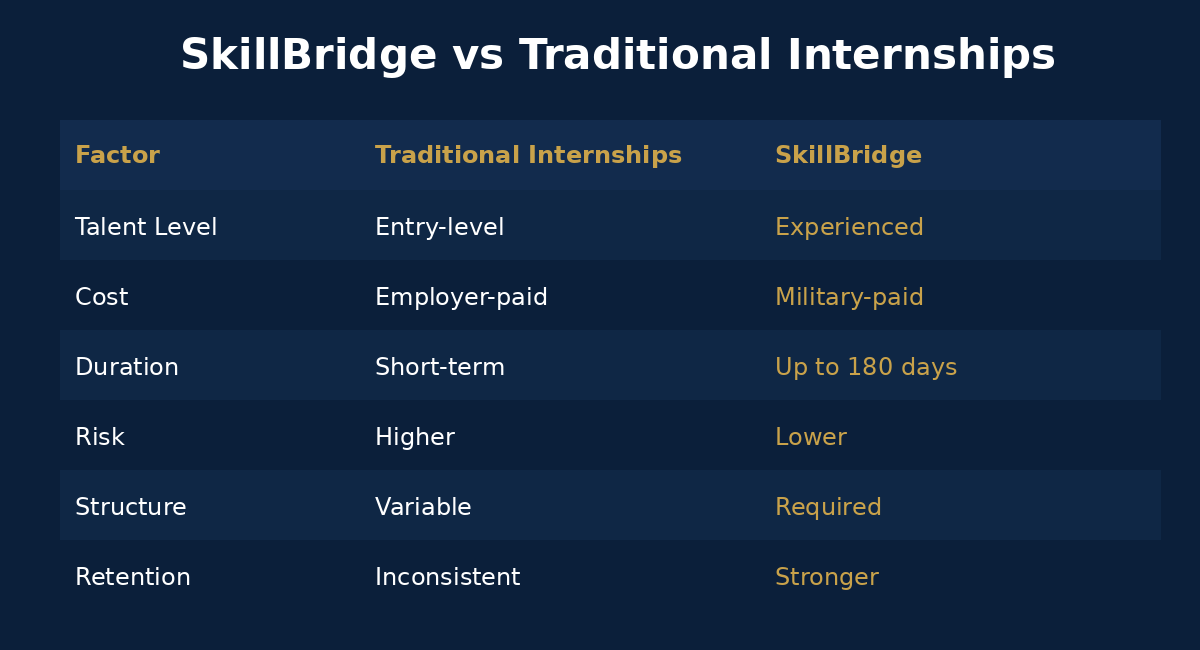
Final Comparison: SkillBridge vs Traditional Internships
Final Takeaway
Traditional internships and SkillBridge serve different purposes, but for many employers, SkillBridge offers a more effective path to hiring.
It combines:
Lower cost
Better evaluation
Higher-quality candidates
Stronger long-term outcomes
Ready to Explore SkillBridge?
If your organization is considering alternatives to traditional internships and wants to:
Improve hiring outcomes
Reduce costs
Build a stronger workforce
Next Missions can help you evaluate, build, and launch a SkillBridge program.
Reach out via email to get started.